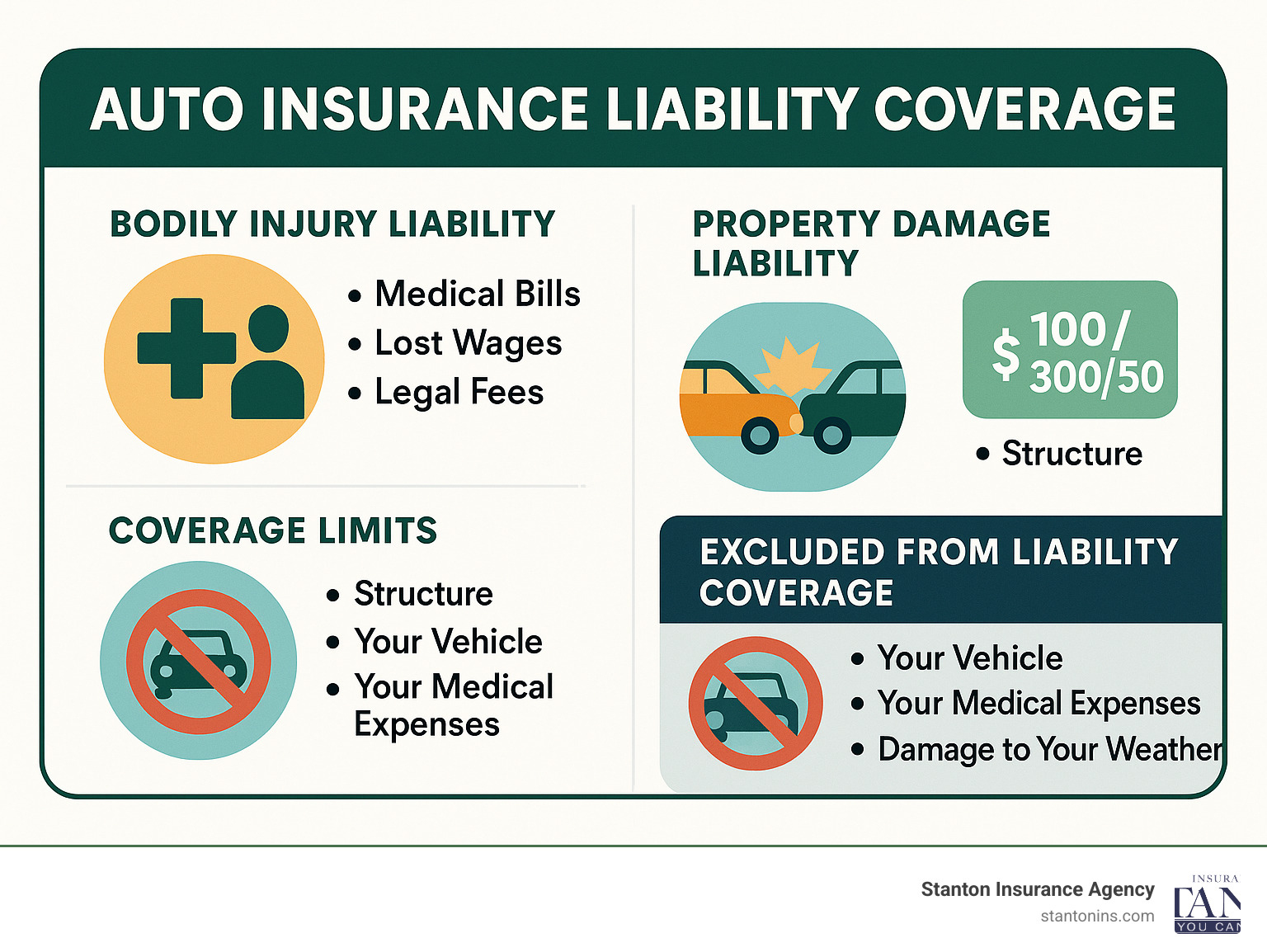
Understanding the **auto liability insurance meaning** starts with recognizing it as a legally mandated safeguard for drivers. This type of insurance covers financial responsibility when an insured driver causes bodily injury or property damage to others in an accident. For example, if a policyholder rear-ends another car, their liability insurance would pay for the other driver’s medical bills and vehicle repairs—up to their coverage limits—without draining their personal savings. Without it, drivers face lawsuits, asset seizures, or even license suspension.
The importance of **auto liability insurance meaning** extends beyond legal compliance. It acts as a financial shield, preventing catastrophic losses from lawsuits or medical expenses. Historically, liability insurance emerged in the early 20th century as car ownership grew, creating a need to manage rising accident-related costs. Today, it remains a cornerstone of responsible driving, with most U.S. states requiring at least minimum limits. This article breaks down how it works, why it matters, and how to navigate its complexities to make informed decisions.
What follows covers the core components of **auto liability insurance meaning**, from how coverage limits function to real-world scenarios where it makes or breaks financial security. Whether comparing policies, understanding legal risks, or optimizing costs, these insights clarify the role of liability insurance in modern driving.
1. What Exactly Is Covered?
**Auto liability insurance meaning** centers on two primary coverages: bodily injury liability (BIL) and property damage liability (PDL). BIL pays for medical expenses, lost wages, and legal fees for injured parties, while PDL covers damage to other vehicles or property. For instance, if a driver hits a pedestrian, BIL would cover their hospital bills; if they collide with a parked car, PDL would repair it. Notably, these coverages exclude damage to the policyholder’s own vehicle—that requires collision or comprehensive insurance.
Coverage limits are expressed as three numbers (e.g., 25/50/25), representing per-person injury limits, per-accident injury limits, and property damage limits (in thousands). A driver with 25/50/25 coverage would pay up to $25,000 per injured person, $50,000 per accident, and $25,000 for property damage. Choosing higher limits reduces out-of-pocket risk but increases premiums. Many states set minimum limits, but experts often recommend higher tiers for adequate protection.
2. Legal Requirements by State
State laws dictate **auto liability insurance meaning** in terms of minimum coverage requirements. For example, California mandates 15/30/5 limits, while Virginia requires only 25/50/20. No-fault states like Michigan add personal injury protection (PIP) to liability coverage. Drivers must carry at least the state minimum to legally operate a vehicle, though failing to do so risks fines, license suspension, or vehicle impoundment. Even in states with lower minimums, underinsured motorist (UIM) coverage can bridge gaps if an at-fault driver lacks sufficient insurance.
Understanding these variations is critical when moving or comparing policies across state lines. For instance, a driver moving from Texas (25/50/25 minimum) to New Hampshire (no minimum but financial responsibility laws) must adjust coverage to comply with local regulations. Always verify state-specific rules to avoid penalties.
3. How Pricing Dynamics Work
The cost of **auto liability insurance meaning** depends on several factors, with coverage limits being a primary driver. Higher limits increase premiums but reduce financial exposure. Other variables include driving record, vehicle type, and location—urban areas with higher accident rates often see pricier policies. Discounts for bundling with homeowners insurance or maintaining a clean record can offset costs. For example, a driver in a low-risk demographic might pay $500 annually for 50/100/50 coverage, while a high-risk driver in a dense city could face $1,200+ for the same limits.
Insurers use actuarial data to price policies, balancing risk and reward. A history of traffic violations or at-fault accidents will inflate rates, while defensive driving courses or low mileage can lower them. Shopping around and comparing quotes from multiple insurers ensures competitive pricing without sacrificing coverage.
4. Common Misconceptions Debunked
- Misconception: Liability insurance covers my car.
This is false. **Auto liability insurance meaning** specifically covers damages to *others*, not the policyholder’s vehicle. Collision or comprehensive insurance is required for that. For example, if a driver hits a tree, their liability policy won’t pay for repairs—they’d need collision coverage. Clarifying this distinction prevents costly surprises after accidents.
- Misconception: Minimum limits are always sufficient.
Minimum limits often fall short of actual expenses. A severe accident could exceed $100,000 in medical bills, leaving the policyholder liable for the rest. For instance, a driver with 25/50/25 limits might face a $50,000 lawsuit if injuries total $75,000. Higher limits (e.g., 100/300/100) provide stronger protection against lawsuits and asset seizure.
- Misconception: Liability insurance is optional.
In most states, it’s legally required. Driving without it risks fines, license suspension, or even jail time. Even in no-fault states, financial responsibility laws mandate proof of coverage. Skipping liability insurance to save money can lead to far greater financial and legal consequences.
- Misconception: It covers uninsured motorists.
Standard liability insurance doesn’t protect against uninsured drivers. For that, **underinsured motorist (UIM) coverage** is needed. Without it, the policyholder absorbs costs if the at-fault driver lacks insurance. UIM coverage ensures compensation regardless of the other driver’s insurance status.
- Misconception: All insurers offer the same coverage.
Policies vary by insurer. Some may exclude specific scenarios (e.g., commercial use) or offer additional protections like rental car coverage. Reading the policy wording ensures clarity on what’s included. For example, one insurer might cover a driver’s legal fees, while another excludes them.
5. Real-World Scenarios Where It Matters
**Auto liability insurance meaning** becomes clear in high-stakes scenarios. Consider a driver in Florida with 10/20/10 limits who causes a multi-car pileup with $150,000 in damages. Their policy would pay up to $20,000 per person and $10,000 for property, leaving them responsible for the remaining $120,000. Without assets to protect, this could mean wage garnishment or bankruptcy. Conversely, a driver with 100/300/50 coverage would avoid personal liability entirely in this case.
Another example involves a distracted driver in New York who hits a cyclist, resulting in $200,000 in medical costs. With 25/50/25 limits, the policyholder would pay the excess $150,000. Higher limits would cap their responsibility at $50,000 per person and $25,000 for property. These scenarios highlight why liability limits should align with potential risks.
6. How to Read Your Policy
Deciphering **auto liability insurance meaning** in policy documents requires focus on key sections. The *declarations page* lists coverage limits and premiums, while the *policy wording* defines exclusions. For instance, a policy might exclude coverage for intentional acts or business use. Always review the *exclusions* and *limitations* sections to understand gaps. A driver who modifies their car for racing might void their liability coverage if the policy excludes modified vehicles.
Pay attention to deductibles (though liability policies typically don’t have them) and any additional endorsements, like roadside assistance or legal defense coverage. Comparing policies side-by-side ensures no critical details are overlooked. For example, one policy might include coverage for a rental car after an accident, while another excludes it.
7. The Role of Deductibles and Limits
While **auto liability insurance meaning** primarily revolves around coverage limits, deductibles play a secondary role in some cases. Standard liability policies don’t use deductibles, but understanding how limits interact with other coverages is vital. For instance, if a driver has $500 collision deductible and causes an accident, their liability coverage would first pay for the other party’s damages before their own collision coverage kicks in. This separation prevents confusion about who covers what.
Limits also interact with state laws. In states with high medical costs, minimum limits may not suffice. For example, a $25,000 injury limit in California could be exhausted by a single hospital bill. Opting for higher limits (e.g., 100/300) ensures broader protection. Always weigh the cost of higher premiums against the risk of financial exposure.
8. Alternatives and Supplemental Coverage
Beyond standard **auto liability insurance meaning**, supplemental coverages address gaps. **Uninsured/underinsured motorist (UM/UIM) coverage** protects when the at-fault driver lacks insurance. **Medical payments (MedPay) or personal injury protection (PIP)** cover policyholder injuries, regardless of fault. For instance, a driver hit by an uninsured motorist would rely on UIM coverage for their medical bills. Similarly, MedPay can reimburse ambulance fees up to policy limits.
Umbrella insurance provides an additional layer of liability protection, extending coverage beyond auto limits. For example, a driver with 100/300/100 auto limits and a $1 million umbrella policy would have $900,000 in extra protection for catastrophic claims. This is ideal for high-net-worth individuals or those with significant assets to protect.
Frequently Asked Questions
Common questions about **auto liability insurance meaning** often revolve around coverage specifics and legal implications.
Question 1: Does liability insurance cover damage to my own car?
No, **auto liability insurance meaning** excludes damage to the policyholder’s vehicle. Collision or comprehensive insurance is required for that. For example, if you hit a pole, your liability policy won’t pay for repairs—only the other party’s damages.
Question 2: What happens if I’m sued after an accident?
If the at-fault driver’s liability limits are insufficient, their assets (or yours, if you’re named in a lawsuit) may be at risk. Higher liability limits reduce this exposure. For instance, a $50,000 medical bill against 25/50 limits would leave the policyholder liable for $25,000.
Question 3: Can I be dropped for too many claims?
Insurers may cancel policies for repeated at-fault accidents or claims. High-risk drivers often face higher premiums or require an SR-22 certificate. For example, a driver with three at-fault accidents in five years might be classified as high-risk and pay double the average rate.
Question 4: Does liability insurance cover rental cars?
It depends on the policy. Some insurers extend liability coverage to rental cars, while others require additional endorsements. Always check the policy wording. For example, Enterprise rental agreements often require primary insurance, but liability may still apply if the policyholder is at fault.
Question 5: How do I lower my liability insurance costs?
Increasing deductibles, bundling with other policies, or maintaining a clean driving record can reduce costs. For instance, a driver with a defensive driving course certificate might qualify for a 10% discount. Shopping around for competitive rates also helps.
Question 6: What’s the difference between liability and full coverage?
Liability insurance covers others’ injuries/damages, while full coverage includes collision and comprehensive insurance for the policyholder’s vehicle. For example, full coverage would repair your car if it’s stolen or damaged in a storm, whereas liability wouldn’t.
15 Actionable Tips to Optimize Liability Coverage
Maximizing the value of **auto liability insurance meaning** requires strategic choices and proactive habits.
Tip 1: Review state minimum limits. Compare them to your assets and potential risks. For example, if you own a home, 100/300/100 limits may be more prudent than state minimums.
Tip 2: Bundle with homeowners or renters insurance. Insurers often offer discounts for multiple policies. A driver bundling auto and home insurance might save 15–20% annually.
Tip 3: Ask about usage-based discounts. Programs like Progressive’s Snapshot or State Farm’s Drive Safe & Save monitor driving habits. Safe drivers can earn premium reductions of up to 30%.
Tip 4: Increase limits gradually. Raising coverage from 25/50/25 to 50/100/50 may add $20–$50/month but significantly reduces out-of-pocket risk.
Tip 5: Check for employer discounts. Some companies offer insurance discounts to employees. For example, a corporate policy might extend to personal vehicles under certain conditions.
Tip 6: Pay annually if possible. Monthly payments often include fees. Switching to annual billing can lower premiums by 5–10%.
Tip 7: Maintain a good credit score. Insurers in many states use credit history to price policies. A higher score can translate to lower premiums. For instance, improving credit from 600 to 700 might drop rates by $300/year.
Tip 8: Avoid unnecessary endorsements. Only add coverage for specific needs (e.g., classic car insurance). Extra endorsements increase premiums without added value.
Tip 9: Compare quotes every 2–3 years. Insurers adjust rates annually. Reevaluating policies ensures competitive pricing. A driver who hasn’t shopped in five years might save hundreds annually.
Tip 10: Take a defensive driving course. Many insurers offer discounts for completing certified courses. A $50 course could yield a $100/year premium reduction.
Tip 11: Park in a garage or secure location. Some insurers reduce rates for low-risk storage. A driver with a gated garage might pay 5–10% less than one parking on the street.
Tip 12: Limit coverage for older vehicles. If a car’s value is low, consider dropping collision/comprehensive insurance. Liability remains mandatory but may be cheaper without extras.
Tip 13: Use an SR-22 only when required. This certificate proves financial responsibility after violations. Keeping a clean record avoids needing it, which can increase premiums by 30–50%.
Tip 14: Document all claims carefully. Accurate records strengthen negotiations with insurers. For example, photos and witness statements can expedite settlements for property damage.
Tip 15: Consult an independent agent. They compare policies across insurers and explain nuances. An agent might uncover a better rate or coverage option not visible online.
Conclusion
The **auto liability insurance meaning** revolves around protecting drivers from financial ruin after accidents they cause. From understanding coverage limits and state laws to debunking myths and optimizing costs, these insights ensure informed decisions. Liability insurance isn’t just a legal obligation—it’s a critical tool for financial security on the road. As driving habits and risks evolve, staying proactive about coverage will continue to pay dividends in safety and savings.
With the right knowledge, drivers can navigate liability insurance confidently, balancing cost and protection to suit their needs. Whether adjusting limits, exploring discounts, or supplementing with umbrella policies, the goal remains clear: minimize risk without overpaying. The road ahead is safer—and more affordable—with a solid grasp of how liability insurance truly works.

