Auto insurance quotes in California represent the starting point for securing affordable, compliant coverage tailored to the state’s unique risks—from Los Angeles traffic congestion to wildfire-prone regions like San Diego. For example, a 30-year-old driver in San Francisco might receive a quote of $1,800 annually for full coverage, while the same policy in rural Fresno could drop to $1,200 due to lower accident rates and theft risks. These quotes aren’t just numbers; they reflect California’s complex insurance landscape, where factors like vehicle type, driving history, and even ZIP code dramatically influence premiums.
The importance of securing competitive auto insurance quotes in California cannot be overstated. With the average California driver paying nearly 20% more than the national average, small differences in quotes can translate to significant annual savings. Beyond cost, quotes reveal coverage gaps—such as insufficient uninsured motorist protection in high-risk areas—or hidden discounts (e.g., bundling home and auto policies). Historically, California’s insurance market has faced volatility, from the 2008 financial crisis to recent rate hikes tied to climate-related claims, making informed comparisons a necessity rather than an option.
This guide breaks down how auto insurance quotes in California work, from the factors that shape them to the best strategies for securing the lowest rates. Whether navigating mandatory liability minimums or exploring usage-based programs, understanding these elements ensures drivers make decisions backed by data—not guesswork.
1. California’s Minimum Coverage Requirements
California law mandates specific liability coverage limits: $15,000 per person for injury, $30,000 per accident, and $5,000 for property damage. These minimums are the baseline for every auto insurance quote in California, but they often fall short of covering severe accidents. For instance, a collision in Los Angeles involving a $50,000 medical bill for a single victim would exhaust the $15,000 limit, leaving the policyholder liable for the remainder. Opting for higher limits—such as 100/300/50—typically adds $20–$50 monthly but shields drivers from catastrophic out-of-pocket costs.
Beyond liability, California requires uninsured motorist (UM) coverage, which pays for injuries or damages when the at-fault driver lacks insurance. About 1 in 7 California drivers is uninsured, making UM coverage critical. A quote comparison might show that adding $100,000 in UM protection costs only $10–$20 more per month but could cover a $200,000 medical bill in a hit-and-run scenario.
2. Factors That Shape Your Quote
The algorithms insurers use to generate auto insurance quotes in California weigh dozens of variables, some within a driver’s control and others not. For example, a 25-year-old male in Oakland with a speeding ticket will face higher premiums than a 45-year-old female in Sacramento with a clean record, even if both drive the same car. Below are the key factors and their real-world impact:
- Location and Commute
Urban areas like San Francisco and Long Beach inflate quotes due to higher accident rates, theft risks, and repair costs. A driver in West Hollywood might pay $2,500 annually for full coverage, while a counterpart in Bakersfield could secure the same for $1,600. Commute distance also matters: a 30-mile daily drive increases collision risk, often adding 10–15% to premiums.
- Vehicle Type and Age
Luxury or sports cars (e.g., a Porsche 911) command premiums 30–50% higher than sedans due to repair costs and theft vulnerability. Conversely, a 10-year-old Toyota Camry with a strong safety rating may qualify for discounts. For example, State Farm quotes for a 2018 Honda Accord in San Diego average $1,200/year, while a 2023 BMW M3 in Los Angeles can exceed $3,000.
- Driving History
A single at-fault accident can raise premiums by 40–60% for 3–5 years. In California, a DUI conviction may trigger a $5,000+ annual surcharge. However, completing a defensive driving course can sometimes mitigate increases. Progressive, for instance, offers a 10% discount to drivers who complete an approved course after a ticket.
- Credit Score
California restricts insurers from using credit scores as a primary factor, but some companies still consider them indirectly. A driver with a 720+ score might save $300–$500 annually compared to someone with a 650 score, as lower scores correlate with higher claim frequencies.
- Coverage Add-Ons
Optional coverages like roadside assistance ($5–$10/month) or gap insurance (for leased vehicles) can add 5–15% to a quote. However, these may prevent financial strain: gap insurance covers the difference between a car’s depreciated value and loan balance after a total loss, saving drivers thousands in the event of an early wreck.
3. How Quotes Differ by Insurer
Not all insurers calculate auto insurance quotes in California the same way. Geico, for example, often undercuts competitors by 10–20% for young drivers but may offer fewer customization options. Meanwhile, Farmers Insurance provides stronger local agent support in rural areas but typically charges 5–10% more for comprehensive coverage. A side-by-side comparison of three major insurers for a 40-year-old in San Jose reveals:
- Geico: $1,500/year for 100/300/50 liability, $500 deductible, no discounts applied.
- State Farm: $1,700/year but includes a 15% multi-policy discount (bundling home insurance) and a $250 deductible.
- Allstate: $1,800/year with a 10% safe driver discount and accident forgiveness after 5 years.
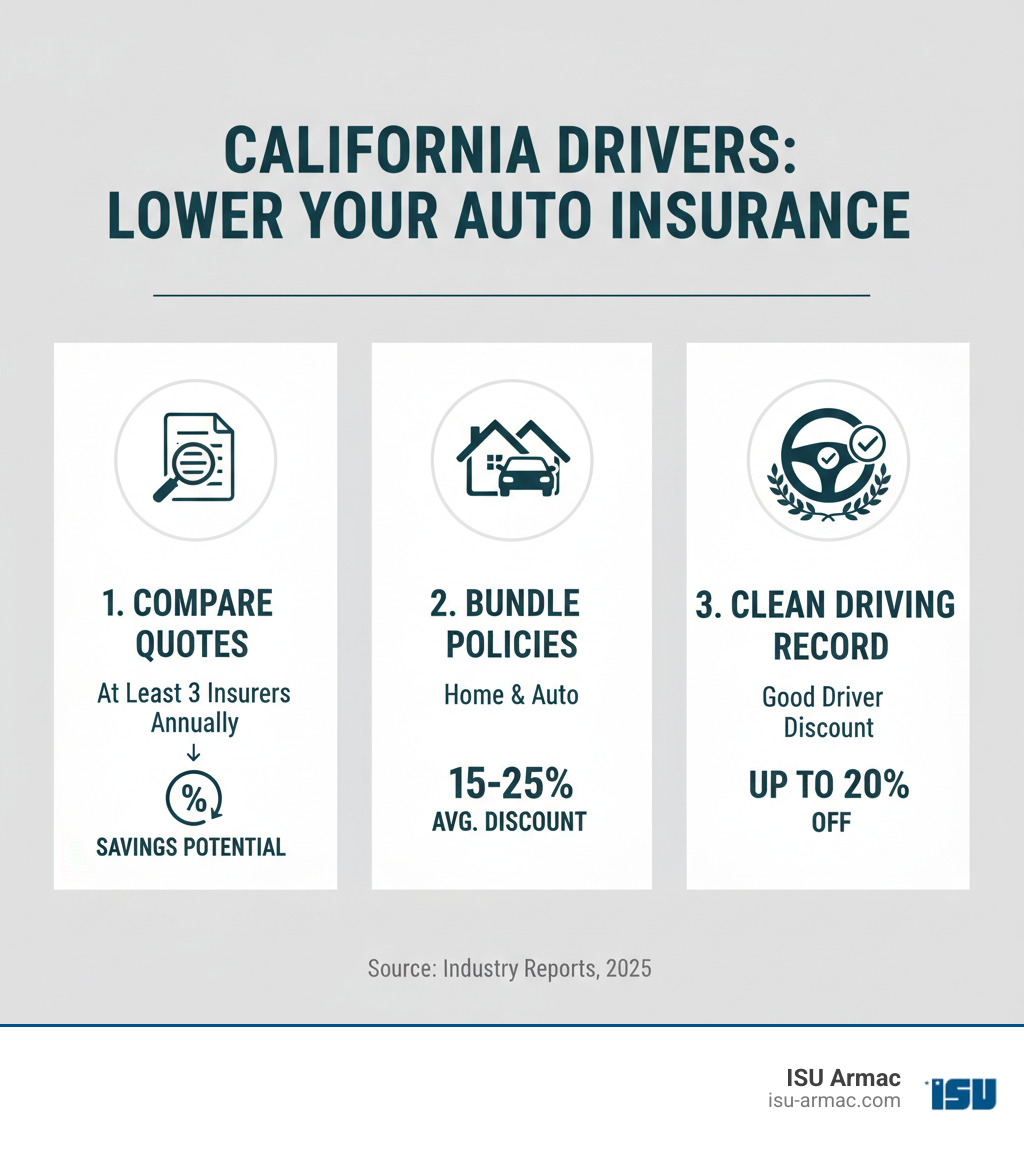
The disparity stems from insurers’ risk models and profit margins. Smaller regional carriers (e.g., Mercury Insurance) may offer better rates in specific counties but lack the national brand discounts of Geico or Progressive. Always compare at least three quotes to identify outliers—such as an insurer quoting $2,200 for the same coverage, which may signal poor underwriting practices.
4. Discounts That Lower California Quotes
California drivers can access dozens of discounts, but fewer than 30% of policyholders apply for them, leaving hundreds of dollars unclaimed annually. Below are the most impactful discounts and how to leverage them:
- Multi-Policy (Bundling)
Combining auto with home or renters insurance can reduce premiums by 10–25%. For example, a driver in Orange County paying $1,800 for auto and $1,200 for home insurance might see a $400 annual discount by bundling, lowering the total to $2,600 instead of $3,000.
- Low Mileage
Drivers logging under 7,500 miles annually may qualify for a 5–15% discount. State Farm’s “Drive Safe & Save” program rewards low-mileage drivers with additional savings, particularly in areas like Palo Alto where traffic is lighter.
- Usage-Based Programs
Telematics tools like Progressive’s Snapshot or Allstate’s Drivewise track driving habits (speed, braking, phone use) and can slash premiums by 30% for safe drivers. A study in Sacramento found that participants in these programs reduced accidents by 20% within a year.
- Anti-Theft and Safety Devices
Installing a LoJack GPS tracker or an anti-lock braking system (ABS) can earn a 5–10% discount. Farmers Insurance, for instance, offers up to $100/year off for vehicles equipped with forward-collision warning systems.
- Affinity Discounts
Memberships in organizations like AAA, AARP, or even alumni associations can yield 5–15% off. AAA’s California-specific policy, for example, often undercuts non-member quotes by $200–$400 annually for full coverage.
5. Common Mistakes That Inflate Quotes
Overlooking seemingly minor details can cost drivers thousands over time. For instance, failing to declare a teen driver on a policy can void coverage entirely if an accident occurs. Other frequent errors include:
- Ignoring Usage-Based Discounts
Many drivers assume their commute or parking habits won’t affect quotes, but telematics data proves otherwise. A 2022 study by the California Department of Insurance found that 60% of drivers who enrolled in usage-based programs qualified for discounts, with an average savings of $350/year.
- Skipping the Shopping Period
Insurers offer a 30-day “comparison window” where switching policies won’t trigger a lapse. Yet, 40% of California drivers fail to take advantage, paying inflated rates for years. A driver in Fresno might miss a $500/year discount by not comparing quotes every 6–12 months.
- Choosing High Deductibles Without Savings
While a $2,000 deductible might lower premiums by $800/year, it also means paying that amount out-of-pocket after a $2,500 hailstorm claim. Financial planners recommend deductibles no higher than what’s covered in an emergency fund.
- Not Updating Personal Details
Moving from a high-risk urban area to a rural one (e.g., from Oakland to Modesto) or improving credit can lower quotes by 20–30%. Yet, only 25% of policyholders update their profiles annually, leaving money on the table.
6. When to Re-Compare Quotes
Auto insurance quotes in California aren’t static; they fluctuate with life changes, market trends, and even insurer promotions. Trigger events that warrant a re-comparison include:
Major life milestones—such as marriage, retirement, or adding a college-aged driver—can alter coverage needs. For example, a newlywed in San Diego might qualify for a multi-policy discount, reducing their combined auto and home insurance costs by $600/year. Similarly, retirees who no longer commute may see premiums drop by 15% after switching to a low-mileage plan.
Market conditions also play a role. After a natural disaster (e.g., the 2017 Thomas Fire in Ventura County), insurers may adjust rates for high-risk areas. Drivers in affected ZIP codes should compare quotes annually, as some companies offer post-disaster relief programs or temporary rate freezes. Additionally, insurers frequently roll out limited-time discounts (e.g., “New Customer: 15% Off First Year”) that can cut initial premiums by hundreds.
7. How to Get Accurate Quotes
Inaccurate information leads to wasted time and higher costs. For example, misreporting a vehicle’s annual mileage as 10,000 instead of 15,000 could result in a $300/year overpayment. To ensure precise auto insurance quotes in California, follow these steps:
- Use the Same Coverage Limits
Compare apples to apples by inputting identical liability, collision, and comprehensive limits across all insurers. A quote for 50/100/25 coverage won’t reflect the true cost of 100/300/50, which is the recommended minimum in high-liability areas like Malibu.
- Provide Exact Driver Details
Omitting a DUI from 5 years ago or listing a teen driver as a “non-primary” user can invalidate coverage. Insurers like Nationwide cross-reference driving records with state DMV data, so discrepancies are quickly caught.
- Check for Regional Insurers
National brands dominate headlines, but local carriers (e.g., Century Insurance in Southern California) often offer better rates for specific demographics. A driver in Riverside might save $400/year by switching from Allstate to a regional provider.
- Avoid “Instant Quote” Pitfalls
Online tools that promise “free quotes” may exclude discounts or use outdated data. Always verify with a licensed agent or the insurer’s direct website to confirm accuracy.
8. Navigating California’s High-Risk Market
California’s insurance market is segmented into “standard” and “non-standard” tiers. Drivers with poor credit, multiple accidents, or DUI convictions often fall into the non-standard category, where quotes can exceed $5,000/year. For example, a driver in Los Angeles with a 0.80% credit score might pay $4,200 annually with a standard insurer but only $3,500 with a non-standard carrier like The General.
High-risk drivers can mitigate costs by:
- Enrolling in the California Automobile Assigned Risk Plan (CAARP), which assigns coverage to drivers who’ve been denied by three insurers. While premiums are high, CAARP ensures compliance with state law.
- Exploring usage-based programs that reward safe driving, such as Metromile’s “pay-per-mile” model, which caps premiums at $300–$500/year for low-mileage drivers.
- Installing aftermarket safety devices (e.g., automatic braking systems) to qualify for discounts, even in non-standard policies.
Even in high-risk scenarios, comparing quotes across 5–7 insurers—including specialty providers—can uncover savings of $500–$1,000 annually.
Frequently Asked Questions
Many drivers have specific concerns when seeking auto insurance quotes in California. Below are answers to the most common questions.
Question 1: Do I need full coverage, or is liability enough in California?
California’s minimum liability coverage (15/30/5) may not protect your assets if you’re at fault in a serious accident. Full coverage (adding collision and comprehensive) is wise if you own or lease your vehicle. For example, repairing a $30,000 Tesla after a rock chip could cost $1,200 out-of-pocket without comprehensive insurance.
Question 2: How often should I update my auto insurance quotes?
At least once a year, or after major life changes like moving, marriage, or buying a new car. For instance, switching from a 2015 Honda Civic to a 2022 Jeep Wrangler could increase your quote by 40%, so re-comparing ensures you’re not overpaying.
Question 3: Can I get a discount for being a good student?
Yes, many insurers (e.g., Progressive, Farmers) offer a 10–20% “good student” discount for drivers under 25 with a B average or higher. This can save $200–$400 annually. Proof, like a report card, is typically required.
Question 4: Why does my quote change after I buy the policy?
Insurers may adjust rates due to updated underwriting data, such as a new speeding ticket or a change in your credit score. Always review your policy annually to ensure accuracy and explore discounts you may have missed initially.
Question 5: Are quotes from online tools reliable?
Online tools provide estimates but may exclude discounts or use outdated rates. For precise auto insurance quotes in California, contact insurers directly or work with an independent agent who can tailor coverage to your needs.
Question 6: What’s the best time of year to compare quotes?
Insurers often introduce promotions in January (post-holiday sales) and September (back-to-school discounts). Comparing quotes during these periods can yield savings of $300–$600 annually.
13 Tips to Secure the Best Auto Insurance Quotes in California
Optimizing auto insurance quotes in California requires strategy. Below are 13 actionable steps to maximize savings and coverage.
Tip 1: Compare at least five insurers. Stick to national brands (Geico, State Farm) and regional players (Mercury, Century) for the widest range of quotes. A driver in San Francisco might find a $600/year difference between the highest and lowest quotes.
Tip 2: Request quotes from the same agent. Independent agents access policies from multiple insurers and can negotiate better rates by bundling. They may uncover discounts, like a 15% loyalty bonus after 3 years.
Tip 3: Choose a higher deductible if you have savings. Raising your deductible from $500 to $1,000 could cut premiums by $400/year. Ensure the deductible doesn’t exceed your emergency fund, though.
Tip 4: Ask about affinity group discounts. Organizations like AAA, Costco, or even your employer may offer 5–15% off. For example, Costco’s auto insurance program often undercuts Geico by $200–$300 annually.
Tip 5: Install a dashboard cam. Devices like the BlackVue DR900 can earn a 5–10% discount and provide evidence to reduce claim costs. Allstate, for instance, offers up to $100/year off for policyholders with verified dash cams.
Tip 6: Review your credit report annually. Errors or improvements can shift quotes by 10–20%. A 50-point credit score increase might save $300/year, while correcting a fraudulent late payment could restore lost discounts.
Tip 7: Consider pay-per-mile insurance. Programs like Metromile cap premiums for low-mileage drivers (under 7,500 miles/year) at $300–$500 annually, saving thousands compared to traditional policies.
Tip 8: Bundle with home or renters insurance. Combining policies with the same insurer can reduce costs by 10–25%. A driver in Sacramento paying $1,500 for auto and $1,000 for renters might see a $300 annual discount by bundling.
Tip 9: Enroll in a defensive driving course. Completing an approved course (e.g., through the California DMV) can lower premiums by 5–10%. Progressive, for example, offers a 10% discount for course graduates.
Tip 10: Check for military or veteran discounts. Insurers like USAA (exclusive to military members) and State Farm offer 5–15% off. Even non-military discounts for veterans can save $200–$400 annually.
Tip 11: Ask about loyalty discounts. Some insurers (e.g., Farmers) reward long-term customers with a 5–10% discount after 5+ years. Staying with the same provider can pay off if they offer better rates than competitors.
Tip 12: Negotiate after receiving quotes. If a quote seems high, call the insurer and ask for adjustments. Mention competitors’ lower rates or highlight your clean driving record to secure a better deal.
Tip 13: Re-evaluate after major life events. Marriage, divorce, or moving can change your coverage needs. For example, adding a spouse to your policy might qualify you for a multi-policy discount, reducing costs by $500/year.
Conclusion
Securing the best auto insurance quotes in California hinges on understanding the state’s unique risks, leveraging discounts, and comparing options rigorously. From navigating mandatory coverage limits to exploiting usage-based programs, each step can trim hundreds—or even thousands—from annual premiums. With California’s market evolving due to climate risks and regulatory changes, staying proactive ensures drivers remain protected without overpaying.
As technology and insurer practices advance, the tools for comparison will become even more precise. By applying these strategies today, drivers can future-proof their policies against rising costs and unexpected challenges.

